


Beneath the seemingly peaceful rubber plantations and farmlands of Cu Chi district lies one of the most sophisticated underground networks ever constructed in modern warfare. The Cu Chi Tunnels represent not just a historical site, but an extraordinary feat of engineering that continues to amaze architects, military strategists, and tourists alike.
When visitors crawl through these narrow passages today, they often wonder: How did ordinary Vietnamese villagers, armed with basic tools, create such a complex underground city? How did they breathe underground for years? How did they cook thousands of meals without detection? How did they build multiple levels that could withstand massive bombing campaigns?
This comprehensive guide explores the remarkable engineering innovations of the Cu Chi Tunnels, revealing the ingenious solutions that allowed thousands of people to live, fight, and survive underground during the Vietnam War. For tourists planning to visit this UNESCO-recognized historical site, understanding these engineering marvels transforms a simple tour into a profound appreciation of human ingenuity under extreme conditions.
The Impossible Challenge: Building Underground Under Constant Threat
To truly appreciate the engineering achievements at Cu Chi, you must first understand the extraordinary constraints under which tunnel builders worked. These weren’t professional engineers with modern equipment—they were farmers, students, and villagers who faced:
Constant aerial surveillance: American aircraft flew thousands of reconnaissance missions over Cu Chi, using advanced technology to detect any sign of enemy activity.
Massive firepower: The area endured some of the most intensive bombing campaigns in history, including B-52 strategic bombers that could drop 30 tons of explosives in a single raid.
Limited resources: Tunnel builders had access only to basic hand tools—primarily hoes, shovels, picks, and baskets for removing soil. No heavy machinery, no power tools, no modern safety equipment.
Time pressure: Construction had to happen quickly, often at night, while maintaining complete secrecy from enemy forces just kilometers away.
Soil conditions: The region’s laterite soil (a clay-rich, iron-heavy earth) was both a blessing and a curse. When dry, it was hard enough to hold tunnel shapes without collapsing. When wet, it became unstable and dangerous.
Despite these seemingly impossible challenges, Vietnamese tunnel builders created an underground network that not only survived but thrived for over a decade. Their solutions to ventilation, cooking, and multi-level construction remain studied by engineers and military academies worldwide.
Mastering Air: The Ingenious Ventilation System (Hệ Thống Thông Hơi)
Perhaps the most critical engineering challenge was providing fresh air to thousands of people living underground. Without proper ventilation, the tunnels would have become death traps within hours due to carbon dioxide buildup, humidity, and lack of oxygen. The solutions developed at Cu Chi demonstrate remarkable understanding of physics, fluid dynamics, and camouflage.
The Science of Underground Airflow
The tunnel ventilation system relied on several key principles:
Natural convection: Warm air rises while cool air sinks. Tunnel builders exploited this basic principle by creating multiple ventilation shafts at different heights, allowing air to circulate naturally without mechanical assistance.
Pressure differentials: By positioning ventilation shafts strategically and varying their heights, builders created pressure differences that drew fresh air through the tunnel network.
Multiple redundant systems: Rather than relying on a single ventilation method, the Cu Chi network employed several complementary techniques to ensure air flow even if some shafts were discovered or destroyed.
Concealed Ventilation Shafts: Hidden in Plain Sight
The most visible component of the ventilation system was the network of camouflaged air shafts that extended from underground chambers to the surface. However, these weren’t simple holes in the ground—they were sophisticated engineering features designed to avoid detection while maximizing air flow.
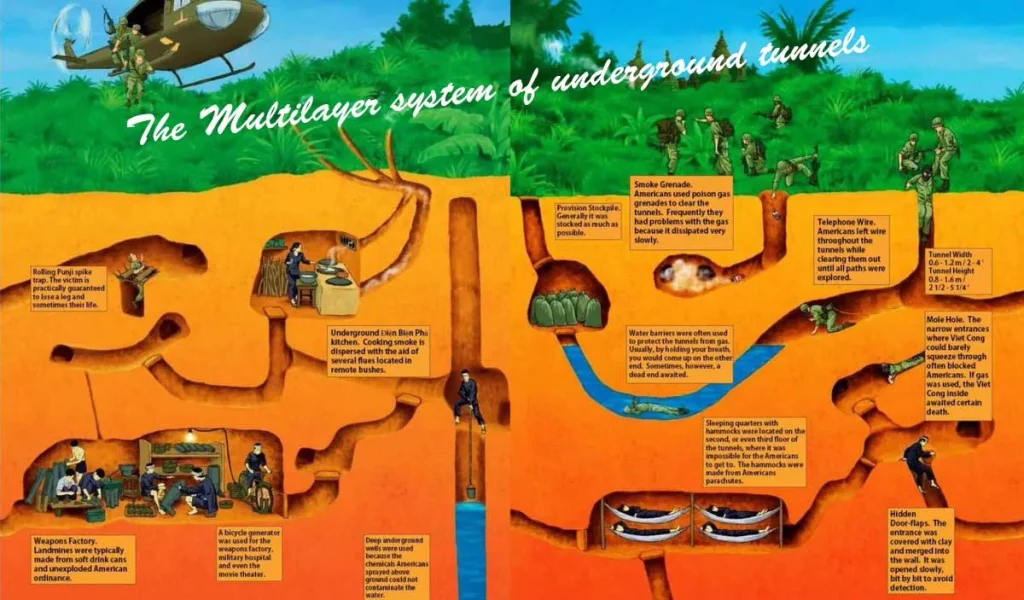
Termite mound disguises: Many ventilation shafts were concealed within artificial termite mounds built on the surface. These mounds were carefully constructed to look identical to natural termite colonies common throughout southern Vietnam. The ventilation pipes ran through the center, invisible to aerial surveillance and ground patrols.
Vegetation camouflage: Other shafts were hidden beneath dense vegetation, with air intake pipes disguised as plant stems or tree roots. Builders selected native plants that would thrive around the shafts, making the area appear completely natural.
Underwater ventilation: Some of the most ingenious shafts extended into nearby streams, ponds, or flooded areas. Air was drawn through submerged pipes, which provided natural filtration and made detection nearly impossible. The water also helped cool incoming air and filter out smoke particles.
Multi-pipe systems: Rather than single shafts, many ventilation points used multiple pipes at different depths and angles. This created complex airflow patterns that were more efficient and harder to detect than simple vertical shafts.
Advanced Filtration and Protection
The ventilation system included several protective features:
Smoke filtration: During bombing raids or when cooking, smoke needed to be filtered before exiting ventilation shafts. Builders created filtration chambers using layers of charcoal, sand, and vegetation that trapped smoke particles and reduced visible emissions.
Water traps: Some ventilation shafts incorporated water traps—U-shaped pipes partially filled with water—that prevented toxic gases from entering the tunnels while allowing air to flow freely.
Blast protection: Ventilation shafts were designed with bends and chambers that could absorb shock waves from nearby explosions, preventing blast damage from traveling deep into the tunnel network.
Seasonal adjustments: The system could be modified based on weather conditions. During the dry season, additional shafts might be opened to increase airflow. During monsoon season, certain shafts could be sealed to prevent flooding while maintaining minimum ventilation.
The Scale of the Achievement
Consider the scope of this ventilation network:
- Over 250 kilometers of tunnels required air circulation
- Thousands of people lived underground simultaneously
- Air had to be refreshed continuously, 24 hours a day
- The system operated for over a decade without mechanical assistance
- Detection would have meant death or capture
The fact that this system worked so effectively, for so long, under such extreme conditions, represents one of the most remarkable achievements in guerrilla engineering history.
The Smokeless Kitchen: Hoàng Cam Stove Innovation (Bếp Hoàng Cầm)
Feeding thousands of people underground presented an enormous logistical challenge. Cooking normally would produce smoke, visible from the air, revealing tunnel locations to enemy aircraft. The solution—the Hoàng Cam stove (Bếp Hoàng Cầm)—represents one of the most ingenious innovations of the Vietnam War, a cooking system that could prepare hot meals for hundreds while producing virtually no visible smoke.
The Problem: Cooking Without Detection
Traditional cooking methods were impossible in the Cu Chi environment:
Aerial surveillance: American reconnaissance aircraft patrolled constantly, equipped with cameras and sensors that could detect even small amounts of smoke.
Infrared detection: Later in the war, infrared technology could detect heat signatures from cooking fires, even through forest canopy.
Ground patrols: Enemy soldiers actively searched for signs of tunnel entrances, including smoke, cooking odors, or disturbed vegetation.
Multiple meals daily: Thousands of fighters and civilians needed three hot meals per day, every day, for years.
The challenge wasn’t just to hide smoke—it was to eliminate it entirely while still cooking food thoroughly and efficiently.
The Ingenious Solution: How Hoàng Cam Stoves Worked
Named after its inventor, the Hoàng Cam stove employed several brilliant engineering principles to achieve smokeless cooking:
Extended smoke dispersion tunnels: Rather than venting smoke directly upward, the stove channeled smoke through a series of underground tunnels extending 10-15 meters from the cooking area. By the time smoke traveled this distance and emerged from carefully concealed exits, it had cooled, dispersed, and become virtually undetectable.
Multi-chamber combustion: The stove featured multiple combustion chambers that burned wood at different temperatures. This complete combustion process minimized smoke production at the source, breaking down organic compounds more thoroughly than traditional fires.
Heat recycling: Hot air and gases were circulated through the tunnel system before exiting, transferring heat to surrounding earth and further cooling the exhaust. This also helped warm underground living spaces during cooler periods.
Strategic exit points: Smoke exits were positioned in locations where natural air currents would immediately disperse any residual vapor—near streams, in dense vegetation, or in areas with consistent wind patterns.
Timing and coordination: Cooking was often scheduled during specific times when weather conditions (wind direction, humidity, cloud cover) would provide additional concealment.
Construction and Operation
Building a Hoàng Cam stove required careful planning:
Location selection: Stoves were positioned deep within the tunnel network, far from entrances, to prevent smoke from accidentally escaping through ventilation shafts or tunnel openings.
Tunnel excavation: Long, narrow tunnels were dug specifically for smoke dispersion, often branching in multiple directions to further dilute emissions.
Chamber construction: The cooking chambers were lined with clay and laterite to withstand high temperatures and improve heat retention.
Fuel preparation: Wood was carefully selected and prepared—dry, seasoned wood burned more cleanly and produced less smoke than green or wet wood.
Operator training: Cooks received specialized training in stove operation, learning to maintain optimal temperatures, manage fuel efficiently, and recognize when adjustments were needed to minimize smoke.
Scale of Operations
The Hoàng Cam stove system operated on an impressive scale:
- Hundreds of stoves operated simultaneously throughout the Cu Chi network
- Each stove could serve 50-100 people per meal
- Cooks prepared three meals daily for thousands of residents
- The system operated continuously for over a decade
- Despite constant aerial surveillance, the stoves remained largely undetected
Beyond Cooking: Additional Applications
The Hoàng Cam stove design proved so effective that it was adapted for other purposes:
Water heating: Modified stoves provided hot water for bathing, medical sterilization, and cleaning.
Food preservation: Controlled heat was used to dry and preserve food for storage.
Medical applications: Sterilization of surgical instruments and preparation of herbal medicines.
Workshop heating: Providing warmth for underground workshops where weapons were repaired and supplies were manufactured.
The Hoàng Cam stove stands as a testament to Vietnamese ingenuity—a simple yet brilliant solution to an apparently impossible problem, allowing thousands of people to eat hot meals while remaining completely hidden from one of the world’s most powerful militaries.
Vertical Complexity: Multi-Level Tunnel Construction (Các Tầng Địa Đạo)
While ventilation and cooking systems solved critical survival challenges, the multi-level structure of the Cu Chi Tunnels represents perhaps the most impressive feat of underground engineering. This wasn’t a single tunnel network—it was a three-dimensional underground city with multiple floors, each serving specific purposes and providing layered defense against enemy attacks.
The Three-Tier System
The Cu Chi Tunnels were constructed in three distinct levels, each with specific characteristics and functions:
First Level (3-4 meters deep):
- Served as the primary living and working area
- Included sleeping quarters, meeting rooms, and storage
- Most vulnerable to detection and bombing
- Used for daily activities and quick access to surface positions
- Connected to fighting positions, trap systems, and camouflage entrances
Second Level (5-6 meters deep):
- Provided additional protection from conventional bombing
- Housed hospitals, command centers, and critical storage
- Included workshops for weapon repair and manufacturing
- More stable temperature and humidity than upper levels
- Connected to deeper emergency shelters
Third Level (8-10+ meters deep):
- The deepest and safest level
- Survived even the most powerful B-52 bombing raids
- Used for long-term storage of weapons, ammunition, and food
- Emergency shelters for extended bombardments
- Most difficult to construct and maintain
- Required sophisticated ventilation due to depth
Engineering Challenges of Multi-Level Construction
Building multiple tunnel levels presented extraordinary difficulties:
Soil stability: Excavating multiple levels increased the risk of collapse. Builders had to understand soil mechanics intuitively, reinforcing weak areas with wooden supports and carefully managing water drainage.
Vertical connections: Stairs and ladders connecting levels had to be:
- Steep enough to minimize space
- Stable enough for daily use
- Concealed from enemy discovery
- Defensible in case of intrusion
- Equipped with trap doors at each level
Ventilation complexity: Each level required independent air circulation while maintaining the overall system’s integrity. Deeper levels needed more sophisticated ventilation due to reduced natural airflow.
Water management: Rainwater and groundwater posed constant threats. Builders created:
- Drainage channels to redirect water flow
- Sump pits to collect and remove water
- Waterproof barriers between levels
- Emergency pumps (manual) for flooding situations
Structural reinforcement: Laterite soil, while generally stable, required reinforcement at key points. Builders used:
- Wooden beams and planks (when available)
- Bamboo supports (abundant in the region)
- Compacted earth walls
- Arched ceilings to distribute weight
Construction Techniques
The methods used to build multiple tunnel levels demonstrate remarkable skill:
Sequential excavation: Builders typically started with the first level, establishing ventilation and basic infrastructure before digging deeper. This allowed them to:
- Remove soil through upper levels
- Maintain air circulation during construction
- Provide escape routes if collapses occurred
- Test soil conditions before deeper excavation
Soil removal and disposal: Excavating over 250 kilometers of tunnels generated enormous amounts of soil. Disposal had to be:
- Completely concealed from aerial observation
- Distributed to avoid creating visible mounds
- Often mixed with surface soil in rubber plantations or fields
- Sometimes used to build fortifications or fill bomb craters
Precision digging: Without modern surveying equipment, builders maintained remarkable accuracy:
- Tunnels connected precisely between different sections
- Vertical shafts aligned correctly between levels
- Gradient was maintained for drainage without being too steep
- Directions were maintained using simple compasses and landmarks
Team coordination: Construction required careful organization:
- Specialized teams for digging, soil removal, reinforcement
- Rotating shifts to work continuously while avoiding exhaustion
- Communication systems between different work areas
- Quality control to ensure structural integrity
Defensive Advantages of Multiple Levels
The multi-tier design provided crucial military advantages:
Layered defense: If enemies penetrated the first level, defenders could:
- Retreat to deeper levels
- Seal off vertical connections
- Fight from protected positions
- Launch counterattacks from unexpected locations
Bombing protection: Different levels provided varying degrees of protection:
- Light bombing might damage only the first level
- Conventional bombs rarely penetrated beyond the second level
- Even B-52 strikes often failed to destroy the third level
- Redundant systems meant functionality could be maintained even with damage
Operational continuity: Multiple levels allowed:
- Critical functions to continue during attacks
- Separation of combat and support activities
- Protection of leadership and medical facilities
- Secure storage of essential supplies
Psychological advantage: Knowing that deep, safe shelters existed boosted morale and allowed residents to endure prolonged bombardments with greater resilience.
Living Conditions Across Levels
Each level offered different living conditions:
First level:
- More natural light (from concealed openings)
- Better air circulation
- Warmer in cool weather
- More vulnerable to attack
- Easier access to surface positions
Second level:
- Cooler temperatures (more stable climate)
- Higher humidity
- Quieter environment
- Better protection
- More difficult for extended habitation
Third level:
- Constant temperature year-round
- Highest humidity requiring careful moisture management
- Complete darkness except for minimal lighting
- Maximum safety but most claustrophobic
- Used primarily for storage and emergency shelter rather than permanent living
The multi-level tunnel system at Cu Chi represents a masterpiece of underground architecture, created without modern technology, under constant threat, by people with only basic tools and extraordinary determination.
Integration: How All Systems Worked Together
The true genius of Cu Chi tunnel engineering wasn’t just in individual innovations—it was in how ventilation systems, Hoàng Cam stoves, and multi-level construction worked together as an integrated whole.
Synergistic Design
Ventilation served multiple functions:
- Provided fresh air for breathing
- Removed smoke from Hoàng Cam stoves
- Controlled humidity across different levels
- Helped regulate temperature
- Dispersed cooking odors that might reveal tunnel locations
Hoàng Cam stoves integrated with tunnel structure:
- Smoke dispersion tunnels doubled as emergency escape routes
- Heat from stoves helped dry damp tunnel sections
- Cooking areas were positioned near ventilation shafts for optimal smoke removal
- Multiple stoves distributed throughout levels prevented bottlenecks
Multi-level design enhanced all systems:
- Deeper levels provided backup if upper ventilation was damaged
- Different levels allowed separation of cooking, living, and storage
- Vertical connections enabled rapid movement while maintaining security
- Redundancy meant system failures on one level didn’t cripple the entire network
Adaptive Engineering
Perhaps most remarkably, the tunnel system was constantly evolving:
- After bombing raids, damaged sections were repaired and reinforced
- New ventilation shafts were added as old ones were discovered
- Tunnel routes were modified based on changing tactical needs
- Cooking facilities were relocated to maintain secrecy
- Lessons from each attack informed improvements
This adaptability required:
- Continuous monitoring of system performance
- Rapid response to damage or discovery
- Ongoing innovation to counter new enemy technologies
- Coordination among hundreds of tunnel residents
What Tourists Can Experience Today
When you visit the Cu Chi Tunnels, you’ll witness these engineering marvels firsthand, though modern modifications have been made for safety and accessibility.
Ben Dinh vs. Ben Duoc Sites
Ben Dinh Tunnels (more tourist-oriented):
- Tunnels widened for visitor comfort
- Better lighting and ventilation
- More extensive above-ground exhibits
- Easier access for average-sized adults
- Demonstrations of Hoàng Cam stove operation
Ben Duoc Tunnels (more authentic):
- Closer to original dimensions
- Narrower, darker passages
- More challenging physical experience
- Includes memorial temple
- Better sense of original conditions
Engineering Features You’ll See
Ventilation shaft demonstrations:
- Guides show how shafts were concealed
- You’ll see replica termite mound covers
- Explanations of airflow principles
- Examples of underwater ventilation systems
Hoàng Cam stove exhibits:
- Functional replicas you can examine
- Smoke dispersion tunnel sections
- Demonstrations of smokeless cooking
- Explanations of the engineering principles
Multi-level tunnel exploration:
- Access to sections of different depths
- Vertical shafts connecting levels
- Reconstructions of living spaces on various levels
- Understanding of how the tiers functioned together
Construction technique displays:
- Tools used by tunnel builders
- Soil samples showing laterite composition
- Reinforcement methods
- Water management systems
Interactive Learning Opportunities
Many tours include:
- Crawling experiences through widened tunnel sections
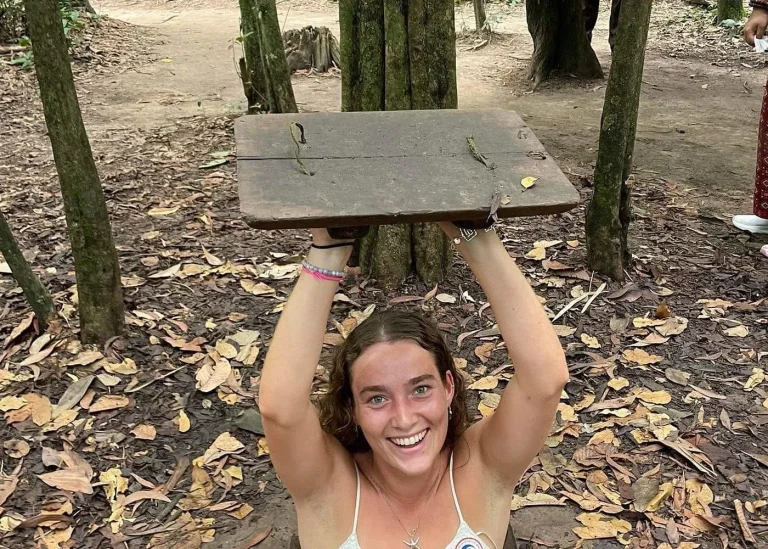
- Trap door demonstrations showing concealment techniques
- Video presentations on construction methods
- Q&A sessions with knowledgeable guides
- Photographic exhibits showing original construction
Practical Tips for Understanding the Engineering
To maximize your appreciation of these engineering achievements:
Before Your Visit:
- Research basic principles of tunnel construction
- Understand the historical context of the Vietnam War
- Watch documentaries about Cu Chi Tunnels
- Read about guerrilla warfare tactics
During Your Visit:
- Ask guides specific questions about construction methods
- Pay attention to details like tunnel dimensions and soil composition
- Take time to examine ventilation shaft replicas
- Try crawling through tunnels to experience the constraints
- Visit both above-ground exhibits and underground sections
Questions to Ask Guides:
- “How long did it take to dig these tunnels?”
- “What tools did builders use?”
- “How did they remove all the soil without detection?”
- “What was the most difficult engineering challenge?”
- “How many people lived underground at once?”
- “How did they prevent collapses?”
Physical Preparation:
- The tunnels are cramped and claustrophobic
- If you have mobility issues, focus on above-ground exhibits
- Bring water—the underground environment is humid
- Wear clothes you don’t mind getting dirty
- Consider your comfort with confined spaces
The Legacy of Cu Chi Engineering
The engineering innovations at Cu Chi Tunnels continue to inspire and educate:
Military studies: War colleges worldwide analyze Cu Chi tunnel tactics and construction methods.
Civil engineering: The ventilation and smoke dispersion systems inform modern underground construction.
Historical preservation: The site demonstrates how to maintain and present historical engineering achievements.
Cultural understanding: The tunnels reveal Vietnamese resilience, creativity, and determination.
Peace education: The site serves as a reminder of war’s costs and the ingenuity humans display under extreme pressure.
Final Thoughts: Engineering Born of Necessity
The Cu Chi Tunnels stand as proof that human ingenuity knows no bounds when survival is at stake. Ordinary farmers and villagers, armed with nothing but determination and basic tools, created an underground network that:
- Provided fresh air to thousands without mechanical systems
- Cooked countless meals without revealing their location
- Built multiple fortress levels without modern equipment
- Survived one of history’s most intense bombing campaigns
- Remained operational for over a decade
When you visit the Cu Chi Tunnels, you’re not just touring a historical site—you’re witnessing a masterpiece of adaptive engineering, a testament to human creativity under pressure, and a reminder of what people can achieve when driven by necessity and determination.
These engineering marvels transformed simple earth into a weapon, a shelter, a hospital, a home, and ultimately, a symbol of resistance. They remind us that innovation isn’t always about advanced technology—sometimes it’s about seeing possibilities where others see only obstacles, and finding solutions where others see only problems.
As you crawl through those narrow passages, breathe the earthy air, and imagine the smokeless kitchens operating deep below, remember: you’re experiencing one of the 20th century’s most remarkable engineering achievements, created not in a laboratory or university, but in the soil of Vietnam, by people who refused to surrender.
Ready to witness these engineering marvels firsthand? Book your Cu Chi Tunnels tour today and prepare to be amazed by what human ingenuity can accomplish. Bring curiosity, respect, and an open mind—and leave with a profound appreciation for one of history’s greatest underground engineering achievements.


Comments